In today’s competitive manufacturing environment, success is increasingly defined by productivity, reliability, and efficiency. Machining strategies that reduce cycle times while maintaining tool life and process stability are no longer optional, they are essential. Among these strategies, High Feed Milling (HFM) has emerged as one of the most effective solutions, and ISCAR has played a leading role in refining and industrializing this technology through proven systems such as LOGIQ-4-FEED, HELIDO FEED, and CHATTERFREE HFM cutters.
High feed milling departs from the traditional concept of removing material through deep axial cuts. Instead, it relies on very shallow depths of cut combined with exceptionally high feed rates and a low entering angle, typically in the range of 10 to 20 degrees. This geometry spreads cutting forces in a more favorable way, enabling the tool to advance rapidly without overloading the cutting edge or the machine spindle. ISCAR’s high feed milling cutters such as the LOGIQ-4-FEED multi-insert system and HELIDO FEED indexable cutters—are engineered specifically to exploit these principles, turning what might seem like light cutting into an extremely productive process.
One of the key reasons ISCAR’s high feed tools outperform conventional milling lies in the way cutting forces are managed. The low entering angle directs most of the force axially, into the spindle, rather than radially against the tool and workpiece. This dramatically improves machining stability, reducing vibration and chatter while minimizing tool deflection. ISCAR addresses these challenges with robust cutter bodies and durable inserts, including HELIDO FEED inserts with strong cutting edges and CHATTERFREE damped toolholders, which deliver stable performance even with long overhangs or on machines with limited rigidity—conditions that often expose the weaknesses of conventional milling approaches.
Despite the shallow depth of cut, high feed milling delivers impressive metal removal rates. The ability to run feed rates several times higher than those used in traditional milling, combined with a consistent chip-thinning effect, allows ISCAR high feed cutters to remove more material per minute in many roughing and semi-roughing applications. Systems like LOGIQ-4-FEED, with four cutting edges per insert, maximize cost efficiency while enabling aggressive feeds. Faster cycle times, improved spindle utilization, and higher overall productivity make ISCAR HFM solutions an attractive choice for manufacturers under pressure to increase output without investing in new equipment.
Tool life is another area where ISCAR’s high feed milling systems show clear advantages. Inserts produced from advanced carbide grades such as ISCAR’s IC830, IC882, and IC808 that feature tough substrates combined with wear-resistant PVD and CVD coatings, are optimized for high-speed engagement and thermal stability. Because cutting forces are distributed more evenly, wear develops gradually and predictably, rather than appearing suddenly in the form of chipping or edge failure. Compared to conventional milling, where tools often suffer from thermal cracking or uneven wear, ISCAR high feed milling tools offer greater reliability and more consistent performance from one tool change to the next.
The benefits become even more apparent when machining difficult materials. Hardened steels, stainless steels, heat-resistant superalloys such as various Inconel or Rene grades, and titanium alloys, as well as tool and mold steels, all pose challenges for conventional milling methods. ISCAR high feed milling tools, particularly LOGIQ-4-FEED for steels and stainless steels and HELIDO FEED solutions for tough alloys, allow manufacturers to maintain aggressive productivity levels in these materials without sacrificing tool life. This makes them especially valuable in aerospace, mold and die, and energy-sector applications.
High feed milling also proves its worth in complex machining scenarios. Pocket roughing, ramping, helical interpolation, and 3D contouring all benefit from the reduced tool engagement associated with shallow cuts. ISCAR’s high feed cutters are designed to support smooth ramping and multi-axis toolpaths, making it possible to machine intricate cavities and complex geometries at high speed with a lower risk of tool breakage—an area where conventional milling often requires conservative parameters and extended machining time.
While conventional milling still has its place, particularly in finishing operations that demand deep axial cuts or ultra-fine surface finishes, high feed milling clearly excels in roughing and semi-roughing operations where speed, stability, and efficiency are paramount. In these situations, ISCAR’s LOGIQ-4-FEED, HELIDO FEED, and related HFM solutions consistently outperform traditional milling cutters.
By combining intelligent tool geometry, advanced materials, and precise control of cutting forces, ISCAR has transformed high feed milling into a robust and highly productive machining strategy. When applied correctly, it delivers shorter cycle times, longer tool life, and greater process reliability. For manufacturers seeking a tangible competitive edge, ISCAR high feed milling is not just an alternative to conventional milling, it is a smarter way to machine.




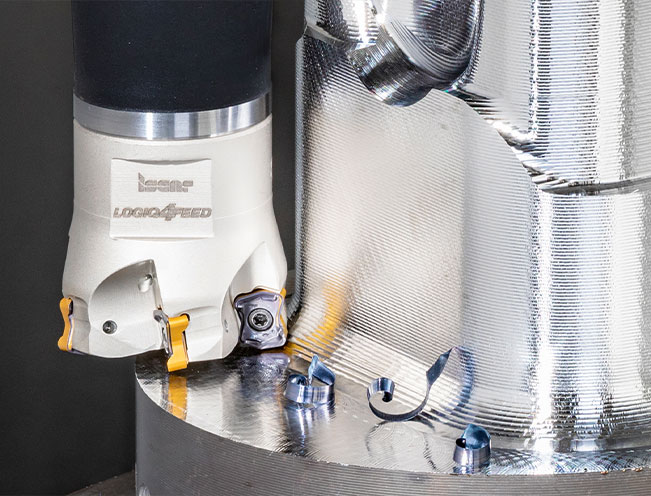 Fig.1
Fig.1
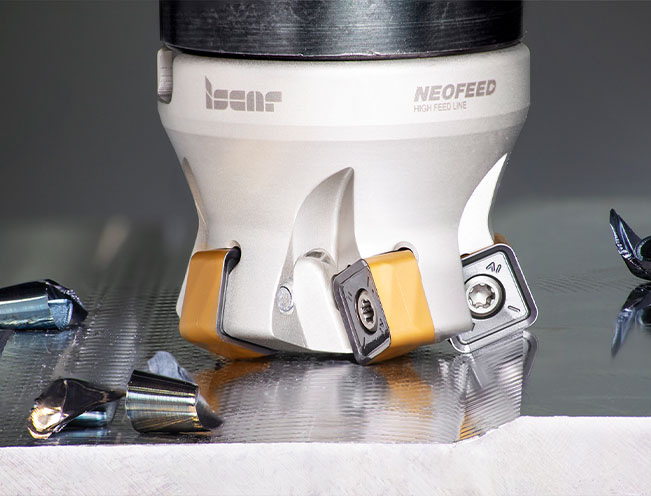 Fig.2
Fig.2